You spent all offseason improving your shot, handle, footwork, and vertical.
Then preseason starts—and two weeks later, your knee hurts, your hamstrings are tight, or you're sitting out with a sprained ankle.
Unfortunately, this pattern is common.
NCAA injury surveillance from 2014–2019 found that preseason injury rates were 34% higher than regular-season rates in men's college basketball and 41% higher in women's basketball.
Don't waste an entire offseason developing your game only to enter the season with a body that isn't prepared to handle it.
Why Are Basketball Injuries More Common in Preseason?
One major reason is the sudden change in what the body is being asked to do.
A player's offseason may include:
Shooting workouts
Ball handling
Individual skill work
Weight training
Pickup basketball
Then organized practice begins everyday and suddenly includes:
Repeated full-court sprints
Hard cutting and deceleration
Contact
Defensive slides
Frequent jumping and landing
Longer practices
Multiple consecutive high-intensity days
Your basketball skills may be ready for the season.
Your physical capacity may not be.
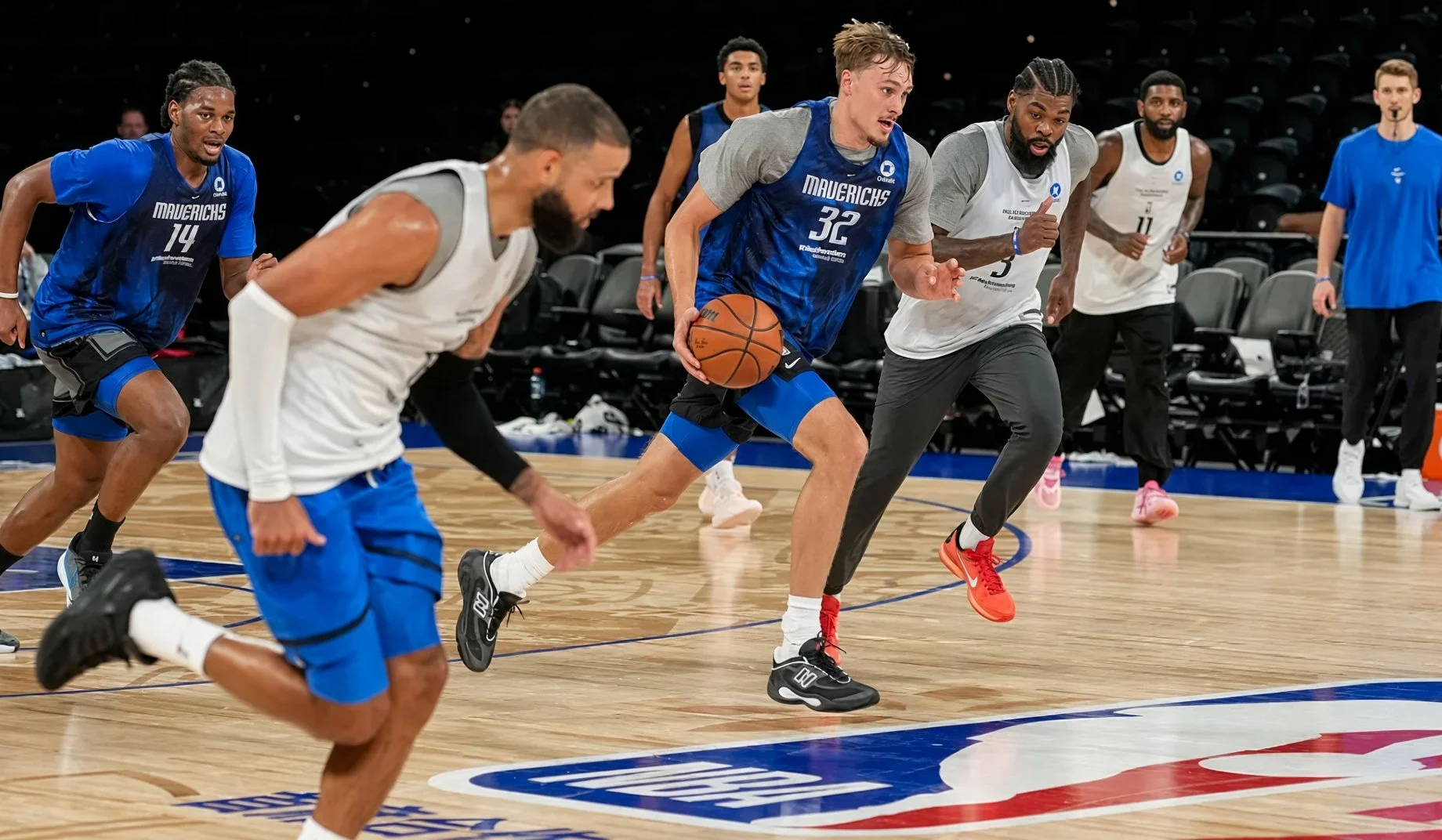
Basketball preseason creates a rapid increase in sprinting, cutting, jumping, and total workload, which can increase injury risk when players are not adequately prepared.
Workload Can Increase Faster Than Capacity
The basic injury-prevention principle is:
When workload consistently exceeds what the body is prepared to tolerate, injury risk can increase.
This doesn't mean hard practices are bad.
Players actually need progressively harder training to build the strength, conditioning, tendon capacity, and movement efficiency required for basketball.
The problem is going from too little to too much too quickly.
Basketball Workload Management: How to Build Capacity and Reduce Injury Risk
Skill Work Doesn't Fully Prepare You for Practice
Getting 500 shots up is valuable.
But it doesn't necessarily prepare your body for a two-hour practice involving repeated sprinting, cutting, jumping, landing, and contact.
This is where offseason development can become too one-dimensional.
Players understandably focus on:
Shooting
Handles
Vertical jump
One-on-one moves
But they also need to prepare their basketball body.
That includes:
Strength
Conditioning
Mobility
Landing ability
Deceleration
Tendon capacity
Recovery
You don't just need the skills to play basketball. You need a body capable of surviving basketball.
What Injuries Show Up During Preseason?
The NCAA data reinforce just how important the lower body is.
From 2004–2014, researchers found that most ankle injuries in both men's and women's college basketball occurred during preseason. Lateral ankle ligament sprains were by far the most common type.
Other preseason problems can include:
Knee pain and patellar tendinopathy
Hamstring, quad, groin, and calf strains
Achilles problems
ACL and other ligament injuries
General soreness and overuse problems
Fatigue can also make landing, cutting, and deceleration more difficult to control.
Landing Mechanics for Basketball Injury Prevention
This Isn't Just a Basketball Problem
The preseason injury spike appears across sports.
Across 15 NCAA sports, preseason practices historically produced 6.6 injuries per 1,000 athlete-exposures compared with 2.3 during the regular season (nearly three times the rate).
NFL data tell a similar story. Training-camp injuries have historically clustered early in camp, and newer NFL research found that introducing a more gradual preseason practice-acclimation progression was associated with a 35% reduction in lower-extremity strains from 2021 to 2023.
The lesson isn't that preseason itself is dangerous.
The lesson is that rapidly transitioning into high workloads before the body is prepared can create problems.
How to Prepare Your Body for Basketball Preseason
1. Increase Basketball Workload Before Day 1
Don't make the first official practice your first truly hard basketball session.
Gradually increase:
Full-court work
Sprinting
Jump volume
Cutting
Defensive movement
Practice duration
Consecutive training days
Your body needs exposure to the movements and workloads it will soon face.
2. Build Strength
Strong muscles help absorb force and protect joints and connective tissues.
Prioritize the:
Quads
Hamstrings
Glutes
Calves
Feet/ankles
Core
Strength isn't separate from injury prevention. It helps build capacity.
3. Condition for Basketball
A poorly conditioned player operates closer to their physical limit throughout practice.
As fatigue increases, movement quality can deteriorate. Then you start stressing structures like your ligaments and tendons more.
Good conditioning makes the same practice less demanding relative to your capacity.
4. Don't Ignore Recovery
Your capacity isn't determined by training alone.
Sleep, nutrition, hydration, stress, joint health, and recovery all influence how much workload your body can tolerate on a given day.
A hard workout doesn't make you better by itself.
Training + recovery = adaptation. This makes you better.
5. Train Landing and Deceleration
Players spend a lot of time training how to jump higher and move faster.
They should also train how to come back down and stop safely.
Practice:
Stick landings
Single-leg landings
Deceleration drills
Change-of-direction control
Prepare Before Preseason Starts
Our 2-Week Basketball Body Durability Starter was built to help players improve the mobility, stability, strength, movement quality, and durability needed to handle basketball.
It's short, basketball-specific, requires no equipment, and can complement your normal skill and team training.
Use the code: BLOG10 to get $10 off the original $39 price!
Don't Waste Your Offseason
Preseason shouldn't be when you start preparing your body for basketball.
It should be when you use the capacity you've already been building and continue to build for the season.
Keep developing your shot. Keep improving your handle. Keep getting more athletic.
But don't forget the foundation that allows you to actually use those skills:
Players can't improve from the sideline. Prepare your body for the season before the season starts.
Go here for our complete Basketball Injury Prevention Guide.