The #1 Movement That Causes Basketball Injuries: Landing
Basketball players jump all the time. Research has shown that professional male basketball players have about 50 explosive jumps per game. And every jump has a landing.
And landings are not soft little events. Landings can expose the body to forces several times body weight, often in a very short time window, which means the ankles, knees, tendons, muscles, and trunk have to absorb force quickly and in a coordinated way.
That is a big reason landing matters so much for basketball injury prevention.
Why landing causes so many basketball injuries
1. Landing is high impact
When a player comes down from a rebound, layup, block attempt, or jump shot, the body has to absorb a lot of force fast. Studies on jump-landing report vertical ground reaction forces that can reach up to 7 times body weight.
If the body does not absorb that force well or is not prepared for that high force; the stress is often more than the body can handle without breaking down..
2. Landing requires rapid coordination
A good landing is not just “bend your knees.” It requires the body to rapidly coordinate the foot, ankle, knee, hip, pelvis, and trunk muscles. That means timing, balance, stiffness in the right places, and enough motion in the right places. We call this “co-contraction.”
Youth players often struggle here because they have not built the strength, control, and movement skill yet. Fatigue makes it even harder, and game-fatigue has been shown to worsen landing biomechanics in basketball players.
3. Basketball creates a huge landing volume
This is not a one-time issue. Basketball players do not just land once. As we mentioned earlier, pro players may jump 50 times a game and this does not include smaller hopping movements. They land over and over across practices, workouts, games, tournaments, and seasons.
That repeated load matters, especially for tendons and other overuse problems. Patellar tendinopathy in particular is tied to repetitive jumping, landing, acceleration, deceleration, and cutting.
4. Most players never really train landing
Players practice shooting, handles, and vertical jump work. But many never spend real time learning how to land with control. So when the game forces a harder, faster, more chaotic landing, they are underprepared.
It’s great to train the skills of the game and to work on being more explosive, stronger, and faster; but unless your body is healthy and on the court, those things don’t matter.
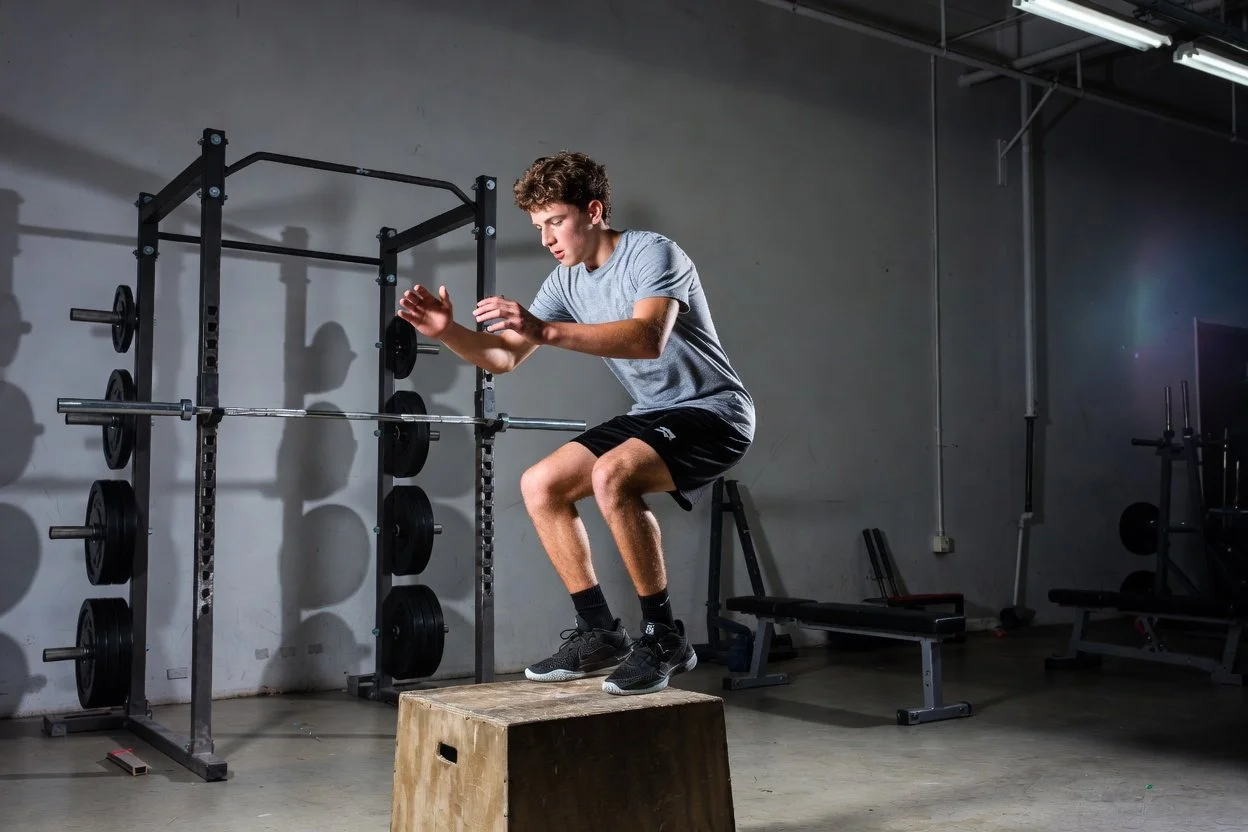
Training landing mechanics with plyometric drills can help basketball players improve force absorption and reduce injury risk.
Common basketball injuries linked to landing
Ankle sprains
Ankle sprains are the most common basketball injury, and landing is one of the classic ways they happen, especially landing on another player’s foot and rolling into inversion. But you’d also be surprised how many ankle injuries are non-contact and many of them happen from landings. Lateral ligament injuries are by far the most common ankle injuries in basketball.
ACL injuries
ACL injuries are far less common than ankle sprains, but much more serious. In basketball, many ACL injuries are noncontact and happen during landing, cutting, or deceleration (landing is a type of deceleration) with poor knee and trunk control. Female basketball players are especially affected.
Patellar tendinopathy
“Jumper’s knee” is a classic basketball problem. Repetitive jumping and landing load the patellar tendon over and over, especially when workload is high and recovery is poor.
Other issues landing can contribute to
Landing may also contribute to Achilles tendon overload, calf issues, bone stress problems such as shin splints, and other lower-extremity overload issues when force absorption is poor or volume gets too high. That is more of a cumulative-load story than a single bad rep story.
How to Decrease Landing Injury Risk
1. Train Your Landing
If jumping is part of basketball, landing should be trained too.
Simple drills:
Stick landings – jump and “freeze” the landing
Snap downs – athletic stance + drop and absorb the force
Low box drop landings – step off box and land under control
Simple, broad coaching cues:
Land softly
Knees track between the hip and ankle and over the 2nd-3rd toe
Hips back slightly, spine stays neutral
Own the landing before the next move
2. Control Your Workloads
Too much jumping too soon is a problem. But so is never preparing for higher workloads.
The goal is to gradually build your capacity so your body can handle more jumping, practices, and games over time.
Examples:
Progress jump volume in training
Be smart after layoffs or injuries
Respect tournament weekends and recovery needs
Capacity grows when workload is progressed properly.
3. Be Strong
Strength helps you absorb force, control positions, and resist fatigue. Stronger athletes generally tolerate landing demands better than weaker athletes.
Focus areas:
Quads
Glutes
Hamstrings
Calves
Core
Instrinsic foot muscles
Beginner’s Guide: 6 Beginner Strength Training Exercises for Basketball Players
More in-depth dive: Principles of a Great Basketball Strength Program
4. Be Mobile
If your ankles and hips are stiff, force often gets pushed somewhere else.
That “somewhere else” is commonly:
Knees
Feet
Low back
Key areas:
Ankle dorsiflexion
Hip internal rotation
Good mobility gives you access to safer landing positions.
Want A Simple Injury Prevention Guide?
If you want to improve your durability and availability right away:
Download our free guide “5 Simple Habits Every Basketball Player Should Build to Stay Injury-Free” by filling out the form below!
What players and parents should take away
If a player jumps a lot, landing should be trained.
That does not mean overcomplicating it. It means:
building strength
improving ankle and hip mobility where needed
practicing deceleration and landing mechanics
managing workload
not ignoring fatigue
Basketball injuries are not just about what happens in the air. A lot of them happen when the player comes back down.
Keep training your skills, but remember that you can only use your skills if you stay healthy. In addition, train to stay available for your team.
Want a simple place to start?
Grab our free guide: 5 Simple Habits Every Basketball Player Should Build to Stay Injury-Free
https://www.basketballmovementlab.com/home#freeguideform