Basketball Injury Prevention: The Complete Guide for Players and Parents
What Is Basketball Injury Prevention?
Basketball injury prevention is the process of preparing your body to handle the physical demands of the game—so you can stay healthy, perform better, and stay on the court.
Because at the end of the day:
The best ability is availability.
If you’re not playing, nothing else matters—not your vertical jump, not your skill work, not your stats.
Why Basketball Players Get Injured
Most injuries aren’t random. They’re the result of a mismatch between what the game demands and what your body can handle.
Want the full breakdown? Read our guide on Why Basketball Players Get Injured (It’s Not Bad Luck).
Basketball is:
High-impact (jumping + landing)
Multi-directional (cutting, decelerating, reacting)
Repetitive (hundreds of jumps, sprints, and cuts per week)
When your body isn’t prepared for that, something eventually gives.
The main drivers of injury:
1. Load > Capacity
When the demands of the game exceed the player’s physical capabilities; injury occurs.
This can be seen over time when the demands of a season add up and wear a player’s body down (classically called an “overuse injury”).
It can also be seen in a moment or a sudden movement that puts a player in a vulnerable position that he or she cannot handle.
2. Poor Recovery
Tired athletes move worse, react slower, and absorb force poorly.
Some of the main things that impact recovery are sleep, hydration, nutrition, and cooling down after workouts.
3. Poor movement patterns
Inefficient landing, cutting, and deceleration mechanics. (read more about how “Landing” is the movement that causes most injuries)
These can cause acute injuries when the load is high enough or can cause “wear and tear” injuries when this happens repeatedly over time.
Half of the solution here is training your body to get into the right positions. The other half of this is making sure your body has the mobility, strength, and stability to even get into the right positions.

Why Staying Healthy Matters in Basketball
For Players
You want to improve. Earn minutes. Maybe even play in college.
But if you’re constantly dealing with pain or missing time…
You’re falling behind—no matter how hard you work.
For Parents
You want your child to stay healthy and reach their potential.
But injuries lead to:
Missed games
Lost confidence
And stalled development
For Adult Hoopers
You just want to stay active, compete, and enjoy the game and the health benefits of playing the game.
But injuries slowly take all of that away and limit how often and how well you can play.
The Reality
You can’t improve, perform, or enjoy the game if you’re not on the court.
Start building habits that keep you there.
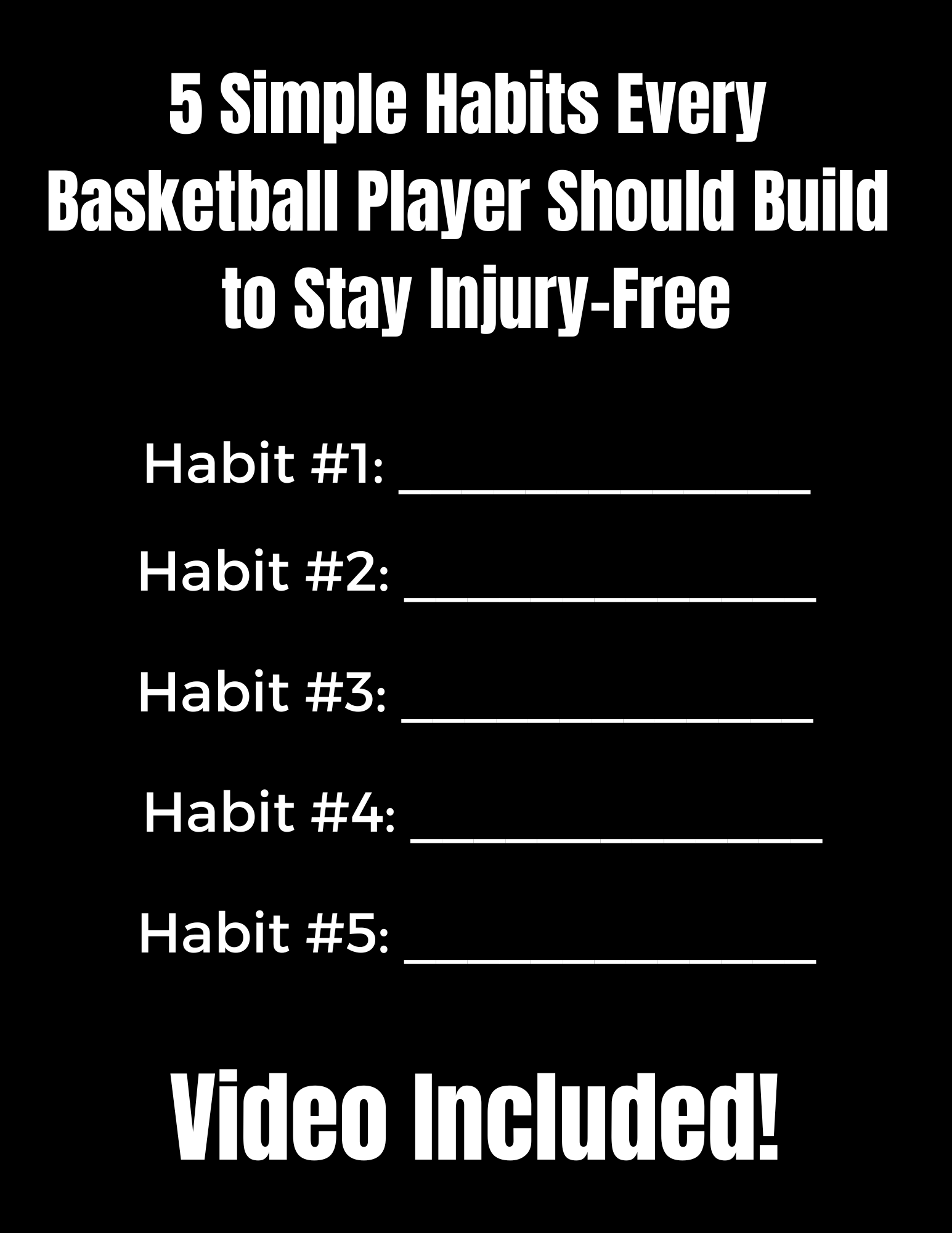
Start below with the free guide "5 Simple Habits Every Basketball Player Should Build to Stay Injury-Free”
The Most Common Basketball Injuries
Basketball has one of the higher injury rates among sports, and the majority occur in the lower body.
Research consistently shows that ankle and knee injuries make up a large percentage of basketball-related injuries, especially in youth and competitive players.
1. Ankle Injuries
Ankle sprains are the most common injury in basketball, accounting for roughly 20–40% of all injuries. Read more in-depth here for preventing ankle sprains in basketball.
They typically occur during:
Landing (especially on another player’s foot)
Cutting or changing direction
Loss of balance under fatigue
2. Knee Injuries
Knee injuries are also extremely common and often develop over time.
These include:
Patellar tendonitis (jumper’s knee)
ACL injuries
General anterior knee pain
These are often linked to:
Repetitive jumping
Poor landing mechanics
High training volume without proper recovery

3. Muscle Injuries
Muscle strains commonly affect:
Hamstrings
Quadriceps
Calves
These injuries often occur during:
Sprinting
Sudden acceleration or deceleration
Fatigue late in games or tournaments
4. Overuse Injuries
Not all injuries happen suddenly.
Many develop slowly over time due to:
High workload (AAU, year-round play)
Lack of recovery
Repetitive stress on the same tissues
These often show up as:
Persistent soreness
Tendon pain
Decreased performance
The key takeaway:
These injuries aren’t random—they’re predictable based on how basketball stresses the body.
Take a deeper dive into the most common basketball injuries and why they occur here.

The Foundation of Basketball Injury Prevention
If you want to stay healthy, you don’t need random exercises.
You need to build a foundation. The game doesn’t care how skilled you are if your body can’t handle it.
1. Movement Quality
Basketball is built on movement. There are ways to move that put more stress on your joints, muscles, tendons, and ligaments; and there are more efficient ways to move that minimize that stress.
Some of the key movements in basketball include:
Landing
Decelerating
Changing direction
If you can’t control your body in those moments, you’re putting unnecessary stress on your joints and tissues.
You don’t just need to move. You need to move efficiently.
2. Strength & Tissue Capacity
Strength isn’t just for performance. It’s also for protection.
Stronger muscles and tendons:
Absorb force better
Reduce joint stress
Improve control under fatigue
And no, this doesn’t mean maxing out squats every week year-round.
It means building appropriate strength for basketball demands. Making your tissues stronger than the forces basketball will impose on you.
Not every strength program is the same. Some can actually do more harm than good. Here’s a more in-depth look at “What to Look for in a Basketball Weight Training Program”.
3. Mobility (That Actually Transfers)
Mobility isn’t about stretching for the sake of stretching. And it’s certainly not about being able to touch your toes.
It’s about having:
Enough ankle mobility to help share the load with your knees when jumping and landing
Enough hip mobility to move efficiently when rotating and cutting
Enough thoracic mobility to stay upright and controlled when jumping for a rebound or shooting
Mobility that you can’t control is useless. Mobility that makes your body move more efficiently is crucial.
4. Workload & Recovery
This is where most players (and parents) miss.
More isn’t always better.
Back-to-back tournaments
Year-round play
No true off-season
All increase injury risk if not managed properly.
And you can’t out-train poor recovery:
Sleep
Nutrition
Scheduling
Learning how to properly manage your workload and recovery will not only help lower injury risk, it can help increase your durability and your resilience.
What a Good Injury Prevention Plan Looks Like
A good plan isn’t complicated—but it is intentional. It should include:
1. Proper Warm-Ups and Cool-Downs
Prepares tissues, activates key muscles, and raises heart rate before activity
Lowers heart rate and muscle tone after activity to kickstart recovery
Improves movement quality, decreases injury risk, and lowers delayed onset muscle soreness
Check out our Ultimate Basketball Warm-Up Guide here
2. Strength Training
Builds resilience
Supports joints
Improves force absorption
3. Movement Training
Working on movement mechanics for landing and cutting
Ankle, hip, and spine mobility
Foot, knee, and core stability
4. Recovery Habits
Sleep, nutrition, hydration
Smart scheduling of workloads
Managing fatigue

Simple Things You Can Start Today
You don’t need a perfect program to start improving.
Start with these:
Take your warm-up seriously (this is not optional)
Pay attention to how you land (quiet, controlled, balanced)
Get in the weight room 2–3x/week
Prioritize sleep (especially during the season)
Don’t ignore small aches and pains
Small problems become big injuries when ignored.
Fill out the quick form below to get the free guide ““5 Simple Habits Every Basketball Player Should Build to Stay Injury-Free”.
Simple, practical habits you can start using right away to stay healthy and consistent all season.
When It’s Time to Get Help
If you’re dealing with:
Pain during or after your basketball activities
Repeated injuries
Declining performance because of aches, pains, or tightness
It’s time to look deeper.
Because if your body isn’t holding up, your game is not going to get better.
Missed practices. Missed games. Missed opportunities.
You don’t have to wait until it gets worse. You don’t have to just hide the symptoms.
Fix the root cause. Move better. Stay on the court.
Click below to Start Your Injury Prevention Plan
Final Thoughts
Basketball is demanding. Injuries are common.
But many of them are preventable.
The goal isn’t just to play—it’s to keep playing.
If you focus only on:
Skills training
Vertical jump
More games and tournaments
…without building your foundation, you’re setting yourself up for problems.
Your movement is your foundation. Your availability is your ceiling.
If you want a simple place to start, download the free guide.
If you’re ready for a complete plan, we’ve got you covered too.