How to Prevent Ankle Sprains in Basketball
Ankle sprains are the most common injury in basketball.
And while they are not 100% preventable, there are many things players can do to reduce their risk.
I’ve heard parents and coaches say before that ankle sprains are just bad luck. While I agree that twisting your ankle by stepping on another player’s shoe is partially bad luck; the majority of ankle sprains are actually non-contact injuries.
Most ankle sprains happen during:
Landing
Cutting
Fatigued movement late in games or tournaments
The most common basketball ankle sprain is an inversion ankle sprain, where the foot rolls inward and stresses the outside ankle ligaments, especially:
Anterior talofibular ligament (ATFL)
Calcaneofibular ligament (CFL)
Basketball places huge demands on the ankle because the foot is the body’s first contact point with the ground.
Why Previous Ankle Sprains Increase Future Injury Risk
This is one of the biggest things players and parents misunderstand.
Many players think:
“I rolled my ankle and I rested, so it healed, I’m good.”
Not necessarily.
After an ankle sprain, several things often happen:
Balance and proprioception decrease
Ankle mobility changes
Muscles around the ankle become less coordinated (and even up to your hip)
Scar tissue can form
The body starts compensating
That means the ankle may not sense position, absorb force, or react as well as before.
This increases risk for:
Another ankle sprain
Knee injuries
Achilles issues
Hip and movement compensation problems
Foot pain and plantar fasciitis
One untreated ankle sprain can change how the entire lower body moves.
This is why reinjury rates are high after ankle sprains, often leading to other common basketball injuries.
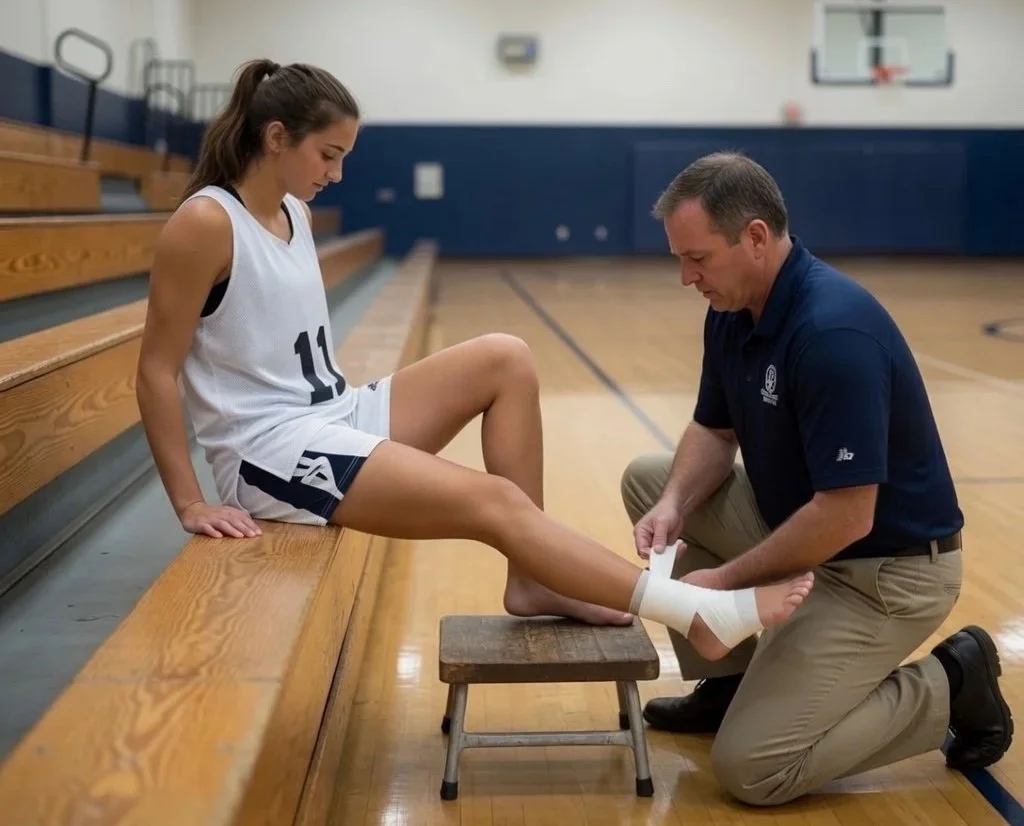
Ankle taping can help support basketball players returning from a recent ankle sprain, but long-term ankle strength and stability training are still important. In the majority of cases, taping and bracing should not be relied on for every practice and game all season.
1. Improve Landing Mechanics
A huge percentage of ankle sprains happen during landing. Especially when your body is moving laterally or rotating.
Good landing mechanics help:
Absorb force through multiple joints
Improve balance and body control
Avoid putting too much stress on the ankle
Simple landing drills:
Stick landings
Snap downs
Single-leg balance hops
Simple cues for these drills:
Land softly
Control the knee and foot
Stay balanced before exploding again
👉 Related: Landing Mechanics for Basketball Injury Prevention
2. Improve Ankle Mobility
If the ankle is stiff—especially limited in dorsiflexion—the body often compensates somewhere else.
That can increase stress on:
Ankles
Knees
Feet
Achilles tendon
Big toe
Simple ankle mobility drills to start with:
Knee-to-wall dorsiflexion drill
Calf mobility work
Dynamic ankle rocks
3. Strengthen the Foot and Ankle
Strong muscles help stabilize the ankle during fast basketball movements.
Important areas:
Peroneals or fibularis muscles (outside ankle stabilizers)
Foot intrinsic muscles
Tibialis anterior
Helpful exercises to begin with:
Single-leg calf raises
Balance work
Barefoot foot control drills
Band-resisted ankle work
Plyometrics
4. Improve Balance and Proprioception
Your ankle is constantly sending information to your brain about body position.
After sprains, that system often becomes less efficient.
Balance training helps retrain it.
Examples:
Single-leg balance
Eyes-closed balance
Single-leg hopping drills
Reactive balance work
Single-leg plyometrics
Research consistently shows balance/proprioceptive training helps reduce ankle sprain risk and reinjury rates.
5. Manage Fatigue and Workload
Fatigue changes movement quality.
Late in games and tournaments:
Balance worsens
Reaction time slows
Force absorption decreases
That is why ankle sprains often happen late in activity.
But this doesn’t mean you just need to stop playing when you get tired. It means you should form a plan and have good habits to make your body more durable late in games and tournaments.
Important factors:
Conditioning
Sleep
Recovery
Gradual workload progression
Your body should be progressively prepared for the demands you place on it.
What About Braces and Taping?
Braces and taping can absolutely have a role, but they are not a perfect long-term solution.
Using external support all the time may:
Reduce ankle muscle demand
Decrease proprioceptive input over time
Shift stress into other joints and tissues that the ankle should be taking
That said, bracing or taping can be very helpful:
After a recent sprain
During return-to-play
During higher-risk periods temporarily
The goal should not be: “Depend on the brace forever.”
The goal should be: “Build an ankle that can function well without needing constant support.”
Want a Program Designed to Help Reduce Injury Risk?
Our basketball injury prevention programs are designed to decrease ankle sprain risk by improving:
Movement quality
Mobility
Strength
Durability
Basketball-specific resilience
Check out our Basketball Injury Prevention Programs below:
Final Thoughts
You cannot completely eliminate ankle sprains in basketball.
The game is too fast, reactive, and unpredictable for that.
But you can reduce your risk by:
Training landing mechanics
Improving ankle mobility
Building strength
Managing workload
Properly rehabbing previous sprains
The best ankle injury prevention strategy is building a body prepared for basketball’s demands.