Why Basketball Players Get Injured (It’s Not Bad Luck)
Most basketball injuries are not just “part of the game.”
Some contact injuries are bound to happen, but most injuries are not random. They’re not just bad luck.
Injuries happen when the demands of the game exceed what the body can handle.
If you understand that, everything changes.
Because now the question becomes: “Is my body prepared for what basketball requires?”
The Real Reason Basketball Players Get Injured
Every injury comes down to one simple equation:
Game Demands > Physical Capacity = Higher Injury Risk
Explosive jumps and sprints
Hard landings
Quick cuts and direction changes
Repeated high-intensity efforts
Contact and endurance
If your body can’t keep up with those demands, something eventually breaks down.
What Makes a Player Breakdown?
There are 2 ways that create the scenario of the demands of basketball being greater than our physical capacity:
A player having a low physical capacity
The game having high physical demands
Let’s breakdown characteristics of both, so you can know how to prevent basketball injuries.
What Decreases Physical Capacity
This is where most players (and parents) miss. This is not being prepared for the demands of the sport.
It’s hardly ever just one thing, it’s a combination.
1. Poor Movement Quality
If you move inefficiently, you place more stress on your body.
Repeated movements form neuromuscular patterns in our brain which then continue to get repeated.
Inefficient patterns put excess stress on joints, tendons, muscles, and ligaments.
Examples:
Uneven loading
Poor landing mechanics
Compensation patterns
The body will always find a way to complete the movement, but not always in the safest way long-term.
2. Lack of Strength Training
Strength isn’t just for performance, it’s also for protection.
Weaker players:
Have joints that take more stress
Have less resilient tendons
Will fatigue faster and therefore be straining quicker
Weak tissue breaks down under load.
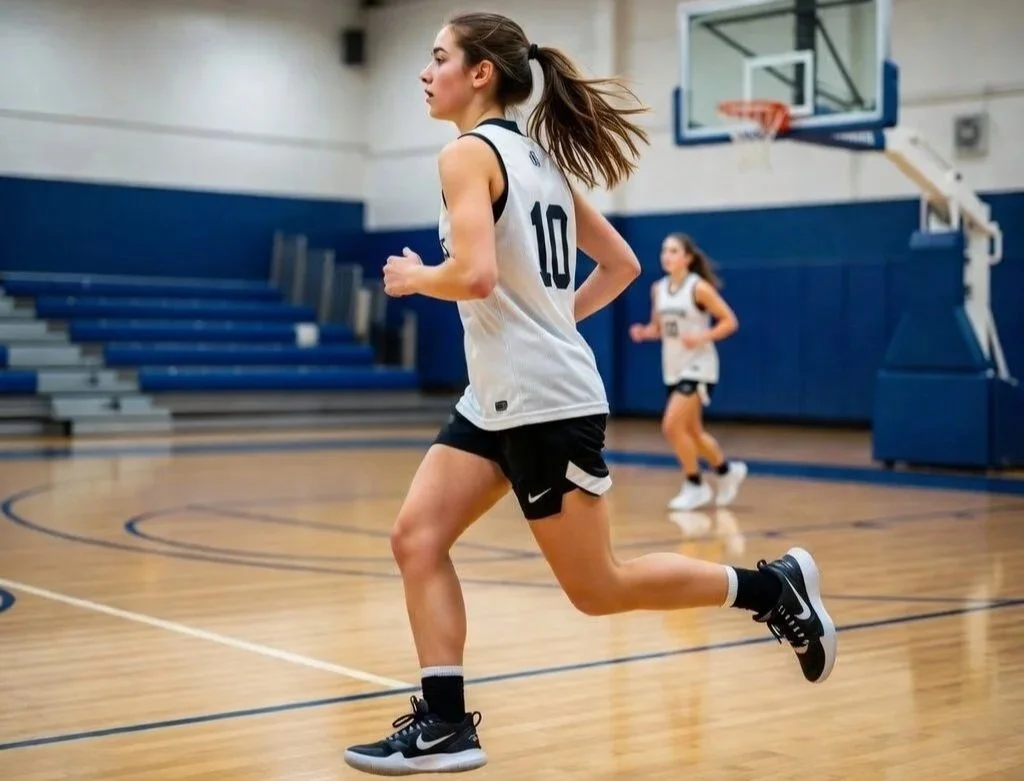
Basketball players need strong conditioning to handle the physical demands of the game and reduce injury risk.
3. Poor Conditioning (Low VO₂ Max)
This one is huge and overlooked.
If your conditioning is poor:
Your body works harder for the same effort
You fatigue faster, physically and mentally
Movement quality drops late in games
If your conditioning is good:
The game feels easier to your body.
And when the game feels easier, your injury risk drops.
4. Poor Recovery (Sleep)
Recovery is where an athlete’s body adapts to the demands it is being exposed to.
Your muscles get stronger, your nervous system becomes more efficient, and your immune system resets.
Without the proper quality and quantity of sleep:
Fatigue comes on quicker
Tissue doesn’t repair fully
Injury risk increases
You don’t just get better during training, you get better during recovery.
Want a Simple Place to Start?
If you want to improve your recovery, movement, and durability right away:
Download our free guide “5 Simple Habits Every Basketball Player Should Build to Stay Injury-Free” by filling out the form below!
5. Poor Nutrition
If you’re not fueling properly:
Your body doesn’t recover as well as it could be
Inflammation could be hindering recovery
Energy levels will not be optimal
This includes:
Not eating enough
Poor food quality
Not refueling after activity or poor meal timing
6. Improper Warm-Up
A weak warm-up = higher injury risk.
If you don’t:
Get your heart rate up
Activate key muscles
Prep movement patterns
You’re asking your body to perform at a high level, but without preparation.
7. Poor Cool-Down (Underrated)
This is one of the most overlooked factors!
A good cool-down:
Lowers heart rate
Shifts your body into recovery mode
Helps muscles relax
If not:
Heart rate stays elevated
Muscle tone stays high
Recovery is delayed
If recovery is delayed, the next session starts from a worse place.
One of the best ways you could start preventing against basketball injuries is by cooling down properly after training sessions and games.
What Increases the Demands of Basketball
Now let’s flip it.
Even if your capacity stays the same, the demands can go up.
Here are some ways that make the demands of the game increase.
1. Better Competition
Higher levels of play = higher demands:
Faster pace
Stronger athletes
More physical play
This can often come from playing against older, more experienced players or simply from playing against teams with higher skill levels.
Better competition stretches your physical limits.
2. Multiple Games in A short amount of time
AAU tournaments are a major factor.
2–4+ games in a day (I once played 6 games in a day when I was a teenager)
Minimal recovery between games and day-to-day
Fatigue builds quickly
That’s where injuries often happen.
Most training doesn’t prepare players for this level of workload.
3. Year-Round Play (No Off-Season)
Minimal time to work on weak links and improve capacity
Minimal time to build strength
The same types of stress over and over again with little variability
4. Sudden Spikes in Activity
Examples:
Tournaments
Camps
Beginning into a new season
Your body hasn’t adapted yet, so there is higher injury risk
5. Playing Through Fatigue or Pain
Movement quality drops (when certain muscle get fatigued, you move differently)
Compensation increases (your body will change the way it moves to try to avoid pain)
Stress shifts to vulnerable areas
Small issues become big injuries when ignored.
The Bottom Line
Basketball injuries aren’t random.
They happen when:
Your body isn’t prepared
Your workload exceeds your capacity
Fatigue changes how you move
Basketball doesn’t create problems, it exposes them!
What Players and Parents Should Focus On
Improve movement quality
Train conditioning
Prioritize recovery
Manage workloads well
Prepare your body for the demands of basketball—and your risk goes down.
Final Thoughts
You can’t control everything in basketball.
But you can control how prepared your body is.
The goal isn’t just to play. It’s to set your body up well to be playing for years to come.